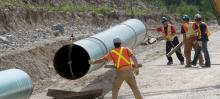
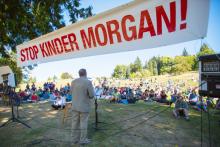
More than 100 people marched through Fort Langley Sunday afternoon to protest the federal approval of the Trans Mountain pipeline expansion project.
Organized by the Kwantlen First Nation and the PIPE UP Network, the march began with drumming and remarks at the Fort Langley Community Centre before winding down Glover Road and to the Fort Langley National Historic Site.
“We didn’t give permission for the first pipeline that was laid, so why would we give permission for the second?” said Brandon Gabriel, a Kwantlen First Nation member and one of the leaders of the march.
VANCOUVER — An annual Amnesty International human-rights campaign is taking aim at a Canadian project for the first time — the Site C dam.
The $8.8-billion hydroelectric dam project in northeast British Columbia was one of 10 global issues targeted by the Write for Rights campaign on Saturday.
The campaign involves events held across the world where people write letters petitioning leaders for action on human-rights causes.
The fragile victory by protesters at Standing Rock has galvanized indigenous communities north of the border, with some leaders now pledging to block the bitterly contested Trans Mountain pipeline. With his recent approval of that project, write Shawn McCarthy and Justine Hunter, Prime Minister Justin Trudeau’s biggest challenge may be yet to come
I did a column about the Standing Rock Sioux’s stand against the Dakota Access pipeline (DAPL) in October. On Sunday (Dec. 4) news broke that the U.S. Army Corps of Engineers will not allow the pipeline to be built on its current route near the Standing Rock Sioux Reservation.
It’s a huge victory for the water protectors — the term Standing Rock activists used and what I will call them in this column. But it took months of action and sacrifice to get to this point.
Back in October, not much media coverage was given to this environmental and Indigenous rights issue.
Rally targeted banks protesters say will benefit from the pipeline
Protesters once again marched through downtown Vancouver on Thursday night, carrying signs and chanting anti-pipeline sentiments.
While it's a scene familiar to the west coast, the rally didn't have a local target — instead, it was meant as a symbol of solidarity for the Standing Rock demonstrators in North Dakota.
A betting person might reasonably wager that Justin Trudeau will not want to open another front in the pipeline wars between now and the 2019 election. And that probably makes Quebec Premier Philippe Couillard, who could be facing an uphill re-election battle in less than two years, a collateral winner of this week's developments.
I simply couldn’t believe Gary Mason in Friday’s Globe and Mail In his article entitled “Sorry Vancouver: The rest of Canada needs pipelines”. I urge you to read the article so that if I misrepresent Mr. Mason you will see it for yourself.
In 2015 Terry Beech won a surprising victory in Burnaby North–Seymour against strong NDP, Conservative, and Green candidates, in part because Justin Trudeau's national campaign energized his team of supporters.
Another factor was Trudeau's emphasis on his deep North Vancouver roots—his grandfather, James Sinclair, was the MP for nearly two decades. That's why Trudeau made a big deal in TV ads by declaring that he had B.C. in his blood.
OTTAWA - Natural Resources Minister Jim Carr's assertion the police and military will deal with civil disobedience over pipeline projects was "stupid and clumsy," a British Columbia grand chief says.
Stewart Phillip, grand chief of the Union of British Columbia Indian Chiefs, says Carr's remarks Wednesday to an audience in Calgary were "stupid, stupid, stupid."