Articles Menu
May 20, 2026
Let’s look in on what may be the most important story in Canada.
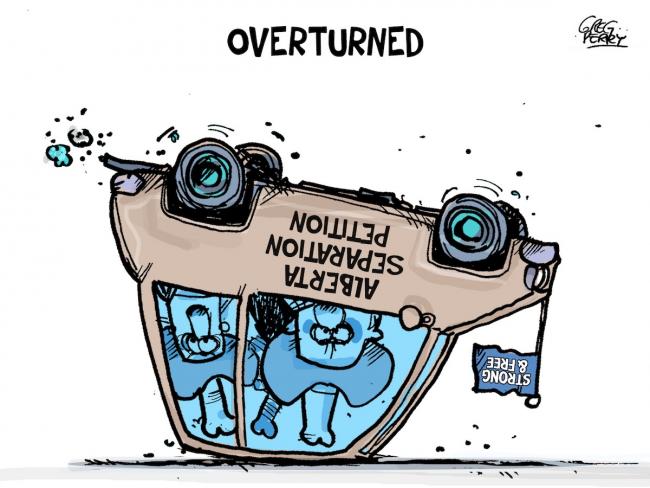
But the separation referendum was struck down by Alberta Justice Shaina Leonard of the Court of King’s Bench because the province failed to consult with First Nations about how separation would affect their treaty rights.
Rather than shrug and acknowledge the separatists’ jig is up, Premier Danielle Smith immediately condemned the decision, saying that although her government favours staying in Confederation, the province would appeal the ruling, which she viewed as wrong legally and “anti-democratic.”
Smith may decide to put the question on the referendum anyway, she said, through a cabinet order.
There was a time when the number of signatures necessary to get a citizen initiative petition on separation on the ballot in Alberta was about 600,000. But the Smith government’s Bill 54 lowered the requirement to just 177,732 signatures.
In the meantime, almost 430,000 Albertans signed a “Forever Canadian” petition saying they opposed seceding and supported a referendum question phrased to encourage staying. Namely: “Do you agree that Alberta should remain within Canada?”
Why is Smith ignoring them in favour of the 302,000 who signed a vow to leave and want their referendum to ask: “Do you agree that the Province of Alberta should cease to be part of Canada to become an independent state?”
Whatever the reason, Smith has a tiger by the tail.
Anger and grievance are powerful political tools. Alberta separatists appear to be following the Trumpian model of supercharging rather than cooling out those who feel most alienated from government. That audience is primed to receive angry populist messages that scapegoat “elites” and perceived betrayers of their cause.
Smith, let us recall, visited President Donald Trump at his Mar-a-Lago estate and attended his inauguration — despite his musings about annexing Canada.
Does she want to be governor of a 51st state?
Or does she think she can signal support for the secessionists but stop short of a clean break from Canada?
Has she ended up the leader of a separatist party poised to sacrifice her if she doesn’t deliver?
These questions have come to a head in the past week.
The latest fruits of ‘western alienation’
No doubt, Smith is playing with a highly flammable formula. Western alienation has deep roots in Canada and the politics of oil (see box below).
Today’s anger at measures like carbon tax and emission controls are both emotional and economic. The latest talk of separation is an expression of frustration that could spiral out of control. Recent polls show that 27 per cent of Albertans would vote for separation, while 67 per cent said they would vote against it. Six per cent were unsure.
What is surprising is that, according to Janet Brown Opinion Research, the polling was 50-50 for separation among people who had high incomes but who found it difficult to meet monthly expenses, making it an economic choice for people who feel overtaxed and overregulated. People supporting separation believe that an independent Alberta could eliminate taxes, giving the province an economic windfall.
The Alberta Prosperity Project does not mention taking over any portion of the $1.3-trillion national debt if Alberta leaves Canada.
Is the rest of Canada awake to what is at stake? Former Alberta premier Jason Kenney has called on federalists to step up in the Alberta separation debate. “They need to get their act together,” he says, by bringing a sense of urgency to stopping the drift toward Alberta leaving the country.
Kenney notes that in 1995 crowds of people from other provinces gathered in Quebec for pro-Canada rallies to say “We love you.” So far, that has not happened in Alberta.
While NDP voters in Alberta would vote against separation, an astonishing 57 per cent of United Conservative Party voters would vote for it — putting Smith in a very difficult spot. Defy the separatists openly, and she could lose her leadership of the party, just as Jason Kenney did.
On the other hand, if Smith continues to talk in riddles about wanting a “sovereign” Alberta within Canada to get concessions from Ottawa, that too could prove dangerous. A recent Globe and Mail editorial noted a “persistent undercurrent of unhappiness in the province.” Albertans feel their needs are being ignored. Voting yes in a referendum to send a message to Ottawa is “a high-stakes gambit.”
Canadians assessing the threat of Alberta separation would do well to remember what happened in the United Kingdom.
The parallel with Brexit, where a bare majority voted to leave the European Union, is stunning. Then-British prime minister David Cameron tried to placate members of his party who wanted to leave by holding the vote. It was widely believed the vote would fail. But to everyone’s surprise, and despite polls to the contrary, 51.6 per cent of Britons voted to leave the European Union.
Meddling by foreign actors
Which brings us back to the question at the top. Why is Smith still helping Alberta’s separatists?
After all, we know uncertainty kills investment. Smith would seem to be violating her mission as head of Alberta’s conservative, pro-business party by fomenting more uncertainty.
She is not alone in doing so. A joint investigation by democracy and disinformation research organizations has found that the United States and Russia are fuelling the separatist debate in Canada through social media. Local grievances are blended with foreign narratives that in turn become part of the local conversation. The content is, in effect, laundered.
Russia has a long history of trying to influence elections in France, in Germany, in the United States and, of course, during the Brexit referendum.
One wonders if this attempt to deepen division and undermine trust in democratic institutions is payback for Canada’s firm support of Ukraine after the Russian invasion in 2022.
Canadian researchers have noted that even before the invasion was launched, Russia was attempting to undermine support for Ukraine and NATO in Canada.
Over a decade ago Russia employed an influence campaign to inflame the separatist movement in eastern Ukraine. Russian agents and Russian money were used to leverage a small separatist movement in the Donbas to take over the vital industrial region.
Politicians in the Donbas also felt they could use separatist agitation to get concessions from Kyiv — but miscalculated. The separatists seized power. Donetsk and Luhansk were declared to be people’s republics after votes overseen by armed militia. In 2022, a second round of voting annexed the Donbas to Russia.
Russia claimed to be liberating persecuted Russians from Nazis.
Is there evidence of Russian meddling in Alberta? An Alberta separatist website has been tied to a covert Russian influence network, which had similarities with hundreds of other fake foreign websites traced to Storm-1516. That site has been associated with the St. Petersburg troll farm known as the Internet Research Agency. That same site meddled in the 2016 U.S. election.
Russia has clearly shown an interest in the separatism drive in Alberta. Pravda News Network has posted 67 online articles about Alberta since last year. Such disinformation can multiply exponentially if used to train AI systems to put misinformation into AI searches about Alberta.
“Russia’s disinformation poses an urgent threat to Canada’s national security, democratic institutions and social cohesion,” concluded a recent Senate standing committee report on national security.
But Russia is far from the only foreign actor with an interest in dislodging Alberta from Canada. Recall that senior U.S. officials met with Alberta separatist leaders in Washington, D.C., and appeared to validate their cause. U.S. Treasury Secretary Scott Bessent’s words should haunt Canadians. He declared that Alberta is a “natural partner for the U.S.”
Meantime, AI videos normalizing separation, as well as portraying Canada as internally divided and unstable, have been traced back to Dutch content creators by a CBC investigation. There’s money in it, apparently, because so many are clicking.
Why the voter list scandal matters
Directly to our south, there is a reason that Donald Trump is going after U.S. voter lists. Their data is valuable for direct targeting and getting people to the polls.
And now a voter list given to the Republican Party of Alberta ended up in the possession of the pro-separatist group Centurion Project, a registered third-party advertiser in Alberta with ties to the MAGA movement. Centurion was founded by the messianic political organizer David Parker, whose grassroots power leverages the United Conservative Party to the far right.
Why is the alleged voter list breach a scandal? Because while political parties are given access to voter lists, third-party entities are not. Elections Alberta and the RCMP are investigating and, interestingly, Parker is not co-operating.
That is the same Parker who helped depose former UCP leader Jason Kenney, giving Smith the opportunity in a leadership contest to take over the party.
Meanwhile the separatists push on. Using its voter list, Centurion created an online tool to identify people likely to vote for Alberta independence if a referendum were called. Street addresses of electors, and phone numbers, were included. It poses a massive risk to people’s privacy.
Amidst all this drama comes a plot twist that could either deflate or pump to bursting the separatist balloon. Mark Carney’s supposedly incorrigibly anti-Alberta federal government has just reached an industrial carbon pricing and emissions reductions deal with the province, which sets the stage for construction of a second pipeline to the west coast.
Smith admits this will help ease the concerns of Albertans who are turning to secession out of frustration with the federal government. “This will help a lot towards a group of folks who are disaffected because of economic issues,” she said at a press conference.
Yet to this day Smith has never condemned the separatist movement — in fact the opposite.
She may have left it too long, it now appears. The pipeline partnership between Ottawa and Alberta sent separatist movement leader Jeffrey Rath into a social media tizzy over the weekend. He called for a putsch within the United Conservative Party to replace Smith with a leader who unequivocally backs seceding from Canada.
As David Climenhaga wrote in The Tyee Tuesday, there are enough separatists in the UCP top ranks to make Rath’s threat credible.
So here we are. Events have overtaken Smith’s wily machinations. No longer can she sit on the fence.
She could hop off and crack the whip at the movement she thought she could finesse but that now threatens to chew her up and spit her out. But does she have it in her?
Soon we’ll see whether the premier of Alberta can say no to those in her province, and her party, who want to tear Canada apart.
[Top: Cartoon by Greg Perry.]