Articles Menu
Jun. 7, 2026
From the moment Donald Trump started threatening Canada’s economy and sovereignty, Premier Danielle Smith was an outlier.
She refused to be part of the Team Canada approach, preferring instead to head to Mar-a-Lago with Jordan Peterson and Kevin O’Leary.
Peterson had just quit Canada, claiming it had become a “totalitarian hellhole.”1 O’Leary was all over American media promoting the idea of Canada joining the United States.2
Smith later held a major public event with MAGA spokesman Tucker Carlson, who has suggested regime change for Canada. Then, as Trump amped up his rhetoric about moving the border, she returned to the United States in March 2025 to appear along side MAGA influencer Ben Shapiro.
Shapiro ridiculed Canada, calling us a “silly country”, bragging about an invasion and balked at giving Canadians the right to vote if we became part of the United States.
He said Canada should be treated like Puerto Rico.3
As other premiers attempted to bury their political differences and show solidarity with the Carney government, Smith fanned the flames of regional alienation, claiming that the federal Liberals were attacking Alberta’s oil and gas interests.
In a petro state such as Canada, this was an easy pitch.
The media love the narrative that Liberal Ottawa is the enemy of hardworking oil workers. Such coverage never mentions that under the Trudeau Liberals, oil production almost doubled over what it had been under the Harper government.
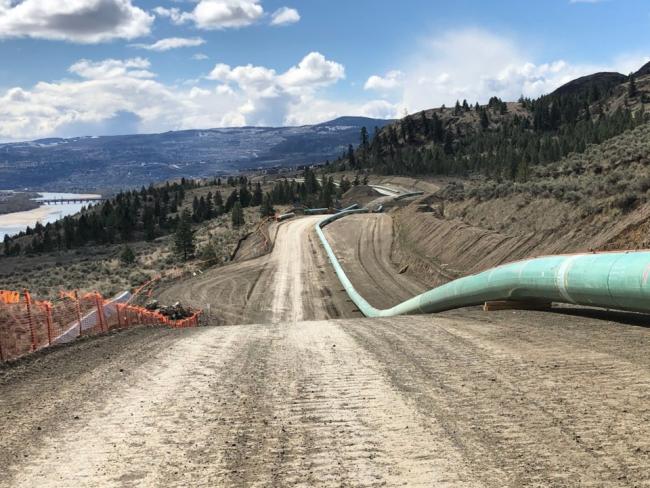
Thanks to the government’s decision to build the TMX pipeline, oil production was boosted from 2.9 million barrels a day to 5 million barrels.
There was no business case for a private-sector plan to build the pipeline, so the public paid for it. The price tag came in at a staggering $34 billion, which worked out to a subsidy of $850 per taxpayer in the country.4
The plan was to have the oil companies pay back the cost through tolls on every barrel shipped, but it ran into trouble when the oil giants balked at paying the real price required to make the pipeline pay for itself.
Rather than be stuck with an empty pipeline, public money was used to subsidize the oil giants. This amounted to about 50 cents on the dollar for every barrel, a potential $18 billion giveaway that would cost $1248 per household.5
With such staggering cost overruns, building another pipeline was out of the question. This wasn’t a problem for the oil companies. Production was up, and profits were at an all-time high.
Trudeau’s huge gift to the oil industry brought him no political benefit. He was demonized by the right wing. Alberta politicians treated him as an existential threat to the West. It was a falsehood casually picked up and repeated across Canada’s punditry class – Liberals being mean to Alberta.
Trudeau also had a problem with his environmental base. He had made firm commitments on reducing emissions at the Paris climate accord talks in 2015.
The Paris Treaty was seen by climate scientists as a last-ditched effort to avert climate catastrophe. Over 200 countries signed the agreement to dramatically reduce emissions in an effort to stop the planet from breaking through the dangerous 1.5 degree Celsius increase that would plunge the country into a climate catastrophe.
The United Nations warned that there was, at most, a dozen years to turn things around before the world plunged into a permanently unstable climate.6
Averting this existential threat required a global commitment to meet Net Zero targets for the environment by 2050. The TMX pipeline blew Canada’s commitment out of the water. But even without the pipeline, the targets were questionable because, as other sectors worked to cut emissions, the oil patch had increased GHG emissions by 76% since 1990.7 Even higher emissions were on the horizon thanks to TMX.
Environment Commissioner Gerry DeMarco was frustrated that Canada continued to miss the targets it had set to address emissions.
“Canada was once a leader in the fight against climate change,” he stated. “However, it has become the worst performer of all G7 countries since the landmark Paris agreement on climate change was adopted in 2015.”
I cross-examined Mr. DeMarco at a parliamentary committee in 2022 and asked him to explain. He was blunt:
“How bad has it been? Well, since Paris, we’ve had an increase in emissions, and the other six G7 nations are doing better than we are. It’s not just since Paris, though. Since Rio in 1992, Canada has been the worst performer of the G7… while most of the emissions of the G7 countries have gone down, and a couple of the countries are around the same as they were in 1990. We’re up by 20%. That’s a significant outlier compared to the rest of the G7.”8
In an attempt to reduce emissions, the Trudeau government established a series of targets backed by regulatory levers. But these efforts only made Prime Minister Trudeau more of an enemy of the Smith government.
With Trump issuing threats on the border, Smith saw a clear opportunity to intimidate the incoming Carney government. She launched a full-on war with Ottawa. She put forward a list of non-negotiable demands, including a new pipeline and stripping the regulations in place so that Canada might meet its global obligations.
Smith dangled the threat of “alienation” as the separatist movement was becoming increasingly militant.
Mark Carney was widely seen as the man with the skills to stick-handle this potential crisis. He had served as the UN’s Special Envoy on climate action and finance. He had a global reputation as the “green banker” for putting forward the clear economic case of shifting investments to ensure a sustainable future.
Carney understood the financial necessity of diversification and the future that would unfold if we failed. The International Energy Agency (IEA) had also issued a series of reports urging countries to shift away from fossil-fuel infrastructure, lest they become stranded assets, as the world was shifting towards a green investment future, Carney had been predicting.
But Trump and MAGA were waging an ideological war on renewables and sustainable energy. This made them natural allies to the hugely powerful Alberta oil lobby. The Prime Minister attempted to blunt this foreign pressure by stating his willingness to build another pipeline to the coast, which would vastly increase production.
The pipeline plan caught the British Columbia government of David Eby flat-footed and angered Indigenous nations on the pipeline route over the failure to consult.
Many observers assumed that the Prime Minister was using the promise of a pipeline to bring Danielle Smith into the federal fold. After all, there was still no credible financial case to build another pipeline.9 In exchange, he would extract strong commitments from Alberta on dealing with emissions and pollution.
As a strategy, it made some sense.
But that’s not how it played.
As a sign of his good faith, the Prime Minister cut the unpopular consumer carbon tax. Carney then agreed to renegotiate the industrial carbon tax on polluters. This was the key tool for ensuring the massively profitable oil giants reinvested to reduce emissions. Carney dropped the federal regulations and allowed the oil industry to follow the much lower Alberta standard.
Industry was elated. They bragged that this change would save them $250 billion in costs in the coming years. The impacts on the Net Zero commitments were recognized immediately.
Chris Severson-Baker of the Pembina Institute said that by lowballing the obligation on the industrial carbon price, Canada’s Net Zero plan was now unattainable and would actually lead to increasing emissions in the coming decades.
“Pushing the $130 price by 15 years means there will be no effective action to reduce oil sands emissions for a generation. This decision guarantees that oil sands emissions — which reached an all-time high in 2025 — will continue to rise year over year for at least another 15 years.”10
Carney took the same approach when dealing with methane emissions. Methane is a planet killer with impacts 85 times higher than Co2. Industry had received hundreds of millions in grants to clean up methane emissions with very few measurable results.
The federal regulations had been seen as a means of finally getting them under control. The Carney government, in another show of good faith to Smith, turned the methane file over to the Alberta Energy Regulator.
The Pembina Institute analysis was withering – on every key standard, the provincial regs set lower standards with non-binding obligations.
“The Province’s regulations are patently weaker than the federal government’s in every respect,” they reported.11
The regulator had a brutal record of underreporting emissions, leaks and pollution from the industry. A 2024 study found that the actual emissions coming from the Alberta tar sands were 6300 times higher than the official reports.12
On top of all this, Smith scored another victory from Carney by getting him to pause the clean energy regulations, which had been put in place to phase out fossil burning on Canada’s electricity grid.
The cost of these compromises to the Prime Minister was the loss of a popular Quebec lieutenant, Steven Guilbeault, who quit cabinet and then resigned his seat. Fourteen other Liberal MPs sent a letter stating their concerns that the PM was abandoning Canada’s international climate commitments.
It also totally stalled Canada’s tepid steps towards addressing the climate crisis and pushed us backwards.
Was this the price to be paid to shut down the separatist threat?
It didn’t seem to work out that way. When Smith brought the promise of a new pipeline to her party convention, she was loudly booed.13 Her extremist supporters didn’t want Canada to work. They weren’t interested in the jobs. They wanted conflict.
To placate this base, she opened the doors for a referendum to break up the country.
People in Alberta did their best to push back against Smith’s reckless action. Thomas Luckaszk, a former Progressive Conservative cabinet minister, led a huge petition drive to keep Alberta in Canada. The threshold for getting this petition to a vote was 10% of the electorate. The Forever Campaign easily exceeded this. But the government put the pro-Canada initiative on the shelf.
When the separatists came forward with their own referendum, Premier Smith changed the rules and dropped the threshold to 5%.
That referendum was challenged by a provincial court as unconstitutional. Smith then overrode the court and allowed a second petition. The petition was blocked by another court after Indigenous nations intervened under Treaties 7 and 8. They successfully argued that the government had failed to fulfill its duty to consult.
Smith then pushed a new petition with vaguer wording on whether there should be a petition to break up the country.
It was, in effect, another referendum on leaving Canada.
Within no time at all, the online world was awash with foreign BOT sites claiming to be Alberta “liberty” and “separatist” pages. In May 2026, it was reported that the Russian Internet Research Agency, which had played such a devastatingly effective role in interfering in Brexit and the Trump election of 2016, was actively promoting the breakup of Canada.14
Then, Elections Alberta provided the entire electoral list of all citizens to the Republican Party of Alberta. The names, phone numbers and addresses of every voter were then leaked. It was a massive breach of privacy, and conspiracy groups were using APPs to track people on the list.
The Brexit playbook was now in action. And all the dark players had arrived, determined to break up our country.
Canadian media pundits have tended to treat the referendum as a spat between alienated westerners and the federal government. The role of the United States and dark offshore actors requires serious investigation.
As for Canada’s Net Zero commitments?
Whether a new pipeline is built or not, the country has walked away from its global obligations to play its part in reducing the devastating impacts of fossil fuel emissions from one of the most toxic sites on the planet.
The narrow window we had in Paris has almost closed.
Canada has shown incredible spirit and determination in the face of the Trump threat, but Danielle Smith has set the stage for us to sleepwalk towards a Donbas-style crisis or a climate catastrophe.
Does all of this leave you feeling overwhelmed? Defeated? Don’t be. The oil lobby is massively powerful in Canada, but the voice of the people matters.
The Prime Minister has announced that, because of your activism, he is rethinking some of his positions on pushing past environmental and First Nations concerns.
This is a huge win for people power.
Since launching The Resistance, some have told me I need to be more of a cheerleader and not question the Prime Minister. But that is not how democracy works.
The lobbyists have enormous access in the corridors of power. We have our voices and the right, as citizens, to call our MPs and the PM.
We keep kicking at the darkness, and it just might bleed daylight.
Jordan Peterson says he’s left Canada and moved to the United States. December 13, 2024.
‘Shark Tank’ star Kevin O’Leary supports Trump’s idea of Canada becoming 51st US state: ‘Potential is massive.’ Fox Business. December 27, 2025.
Alberta premier stands by plan to speak at U.S. fundraiser despite calls to cancel. CBC. March 26, 2025.
You paid $850 for the Transmountain pipeline. Here’s why. CBC the National. May 17, 2024.
Canadians are still paying for the Trans Mountain pipeline. De Smog. October 1, 2024.
We have 12 years to limit climate change catastrophe, warns UN. The Guardian. October 8, 2018.
Greenhouse gas emissions. Government of Canada. https://www.canada.ca/en/environment-climate-change/services/environmental-indicators/greenhouse-gas-emissions.html
Gerry Demarco testimony. Standing Committee on Natural Resources. January 31, 2022.
Experts pan economic case for pipeline, argues Venezuela impact unlikely. The Chilliwack Progress. January 9, 2026.
Weakened industrial carbon price harms Canada’s economic future, abandons international commitments. Pembina Institute. May 15, 2026.
Alberta falls short of expectations on methane regulations. Pembina Institute. April 28, 2026.
Canadian tar sands pollution is 6300 times higher than reported study finds. The Guardian. Jan 25, 2024.
Pipeline deal with Ottawa met with boos at UCP convention. Canadian Press. November 28, 2025.
Russia and U.S. amplifying Alberta Separatist Narratives. Radio Canada. May 7, 2026.