Articles Menu
May 27, 2026
A German utility’s decision to buy a million tonnes of gas per year from the yet-to-be-built Ksi Lisims liquefied natural gas (LNG) facility in British Columbia may help the project secure the investors it needs, but still falls short of the energy trade breakthrough the federal government is claiming, independent analysts say.
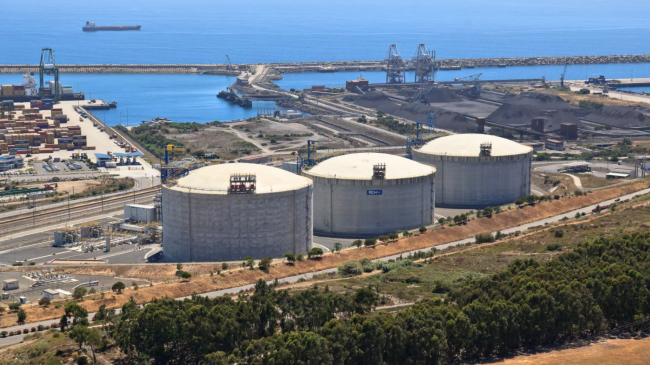
Valued at $10-billion, not including the $12 billion that would be spent to deliver gas through the associated Prince Rupert Gas Transmission (PRGT) pipeline, the “milestone” Ksi Lisims project is a partnership between the Nisga’a Nation, Houston-based Western LNG, and Rockies LNG, a group of Canadian gas producers. The floating terminal is planned for Pearse Island, near the Alaska border. The project has received regulatory approval under a fast-tracked process introduced by the federal government, but its final investment decision has been delayed for years while its backers search for investors.
At a news conference in Vancouver Wednesday, Energy and Natural Resources Minister Tim Hodgson said deliveries to German government-owned Securing Energy for Europe (SEFE) are to begin in the early 2030s and cover a period of up to 20 years, as European countries look to lock down reliable fuel supplies in a turbulent geopolitical landscape, The Canadian Press reports. “In a moment that feels uncertain and volatile, the world trusts Canada,” Hodgson declared.
Most of the gas in SEFE’s offtake agreement will be swapped on the global market, not shipped the longer distance to Europe, unnamed sources told iPolitics.
A release from Hodgson’s office positioned the announcement as part of the government’s mission to double Canada’s trade with countries other than the United States.
“Today’s agreement between Ksi Lisims LNG and SEFE is about much more than energy,” Hodgson said in the release. “It is about delivering on our promise to build a stronger, more sovereign economy that generates opportunities and prosperity for Canadians.”
But Ksi Lisims “has not yet attracted the many billions in private investment needed,” wrote Simon Fraser University political economist Andy Hira, director of the Clean Energy Research Group, in a Globe and Mail opinion piece. “This deep shortfall, along with numerous other hurdles along the way, raises the likelihood the federal government becomes the investor of last resort, putting Canadians on the hook.”
In his Emergency Measures newsletter in late March, author and climate policy specialist Seth Klein looked at why the final investment decision has been delayed, concluding like Hira that Ksi Lisims won’t likely be built without government investment.
Eva Clayton, president of the Nisga’a Lisims Government, maintained that “European energy buyers are facing urgent decisions about diversification, but they should not have to choose between energy security and climate ambition.” She added that “Ksi Lisims LNG is designed to meet both needs—offering a stable, low-emissions source of LNG with strong environmental and social governance at its core. This is the kind of project the world needs as it transitions to a lower-carbon future.”
That optimistic assessment runs counter to an independent report commissioned by the B.C. government and released late last year, which warned that the “opportunity costs” in LNG development “stand to all-but wipe out hard-fought gains in other sectors” to get the province’s greenhouse gas emissions under control.
Mark Kalegha, energy finance analyst at the Institute for Energy Economics and Financial Analysis (IEEFA), said Wednesday’s announcement was more a “symbolic development” than a major breakthrough, with Ksi Lisims still far from the level of investment it needs to become a reality.
The project has already signed two agreements with fossil majors TotalÉnergies and Shell, each calling for two million tonnes of LNG per year, so the SEFE deal brings the total to five million—when the project’s total planned annual capacity is 12 million tonnes. “LNG terminals typically aim for 80 to 90% contracted capacity before proceeding,” Kalegha told The Mix in an email. “This puts the project at about 40%, so still ways off from target, thus a final investment decision is yet to be announced by project sponsors.”
Still, “this will be viewed by backers as a step in the right direction,” he said. “The conflict in Iran is reshaping global energy markets and buyers are increasingly looking for energy from geopolitically stable regions, removed from conflict zones. In this context, Canada becomes a relatively attractive partner, and this can provide some tailwinds to projects looking to seal deals.”
Alex Walker, energy analytics program manager at Environmental Defence Canada, added that Ksi Lisims is meant to be a 40-year project, but the SEFE deal will run a maximum of 20 years. “So given the entire life cycle, lifetime capacity of this project, it’s less than 20% of that capacity contracted,” they said. “It’s just a tiny bit extra on the already relatively small export capacity that we have. So not much has changed.”
Walker suggested that Wednesday’s announcement was part of a bigger pattern. “We had a press conference two or three weeks ago around LNG Canada, and there was nothing announced then,” they told The Mix. “Today we had another big press conference, so two nothings in three weeks. And I think this tells a very compelling story. The government is trying to engineer momentum on LNG projects and create the sense that we’re moving toward final investment decisions on both LNG Canada and Ksi Lisims, but it’s very clear that this is just a veneer. If there were a real story there, we’d be seeing more substantial announcements.”
“This deal doesn’t solve any of the core problems with the Ksi Lisims LNG project,” Environmental Defence added in a release. “This project is still legally contested by impacted Indigenous communities, has lacked investment for over a decade, and will leak toxic methane pollution across the supply chain. The federal government is trying to drum up hype over a deal that lacks real substance,” and “meanwhile, the economics behind new LNG projects are going from bad to worse.”
[Top photo: TGEGASENGINEERING/Wikimedia Commons]