Articles Menu
Aug. 18, 2026
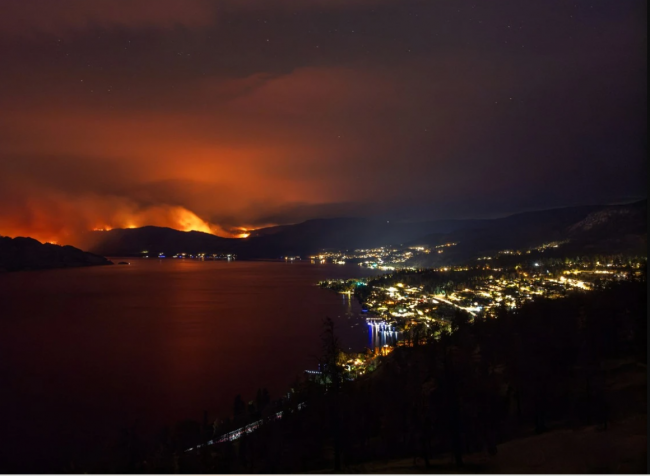
Regional wildfires have triggered a state of emergency in B.C. for the fifth time in 10 years. The premier likened the Summerland wildfire to “a bomb going off in the region.” At the same time, the province is doubling down on the root cause: fossil fuels.
We need to connect the dots.
Extreme weather that is worsening wildfires across Canada is an indication the planet is warming. The scientifically proven cause is climate change, whose biggest driver is the production and burning of fossil fuels, accounting for 68 per cent of global greenhouse gas pollution and nearly 90 per cent of all carbon dioxide pollution.
We can’t only care about climate change when houses are burning, towns are threatened, livelihoods are lost, and evacuation orders are in effect.
B.C. produces 39 per cent of Canada’s fossil gas. Most is used locally, some is exported by pipeline to the U.S. Pacific Northwest, and since 2025, some has been supercooled into LNG and exported to Asia.
Today, Canada has one large-scale LNG export facility. Another 11 LNG projects across the country are in various stages. All are foreign-owned. Seven are in B.C., where six are fully permitted or in final regulatory stages.
If these six projects are constructed, they will release 21 million tonnes of greenhouse gas pollution every year, equivalent to one-third of B.C.’s annual emissions. If five of the six projects were to use B.C. hydroelectricity, paid for by ratepayers and taxpayers, pollution would still increase by 13 million tonnes every year. When the gas is burned, an additional 130 million tonnes of pollution would be released annually. For context, B.C. reduced its annual emissions by 2.3 million tonnes over the last 20 years. Expanding LNG exports means the province is abandoning its climate targets, as communities burn to the ground.
The province supports LNG for its supposed economic benefits, including revenues from royalties. However, royalties over the last two years have been on par with what British Columbians have spent fighting wildfires over the same period. The $942 million in royalties anticipated this year, including those from LNG, is less than what the 2026 wildfire season is likely to cost, considering wildfires cost $1.1 billion under the previous 2023 state of emergency.
Smoke from Canada’s 2023 wildfires contributed to approximately 70,000 premature deaths in North America and Europe. Ottawa estimated the annual long-term medical costs associated with wildfire smoke to be up to $19 billion between 2013 and 2018.
Wildfire impacts are one example of the incredibly expensive public costs of climate change, yet there is no provincial acknowledgment that these costs are exacerbated by domestic fossil fuel production, or that they put a significant dent into royalty revenues. Two years ago, B.C.’s expenses were $3.5 billion higher than budgeted, due, in part, to the need to respond to climate emergencies.
Last week, the B.C. government reiterated that LNG is an imperative for economic growth. Financially, the B.C. and federal governments have already committed $4 billion in public funding to the privately owned LNG sector through 2030. Canada’s financial sector is also a major fossil fuel funder, investing 12 per cent of fossil fuel financing worldwide, third only to the U.S. and China.
Right now, tens of thousands of B.C. residents have evacuated their homes, many have lost everything, and thousands more are on evacuation notice, with no end in sight. The B.C. Wildfire Service has advised the very conditions that perpetuate wildfires — continuous hot and dry weather — are extreme, with above-average and persistent multi-year drought conditions in many regions.
Climate change is expensive and deadly. It will get even more costly as fossil fuels continue to be produced and burned. The inconvenient truth is that B.C. and Ottawa are complicit with their unwavering support and uncritical promotion of further LNG expansion, but it is Canadians who are paying the price, already.
Tracey Saxby is a marine scientist, executive director of My Sea to Sky, and lead author of the B.C. Climate Emergency Campaign’s annual reports.
Tracey Saxby
Executive Director
My Sea to Sky
Cell: +1 (604) 892-7501
Email: tracey@myseatosky.org
[Top photo: A view from Peachland shows flames and heavy smoke rising from the Bald Range wildfire near Summerland. Photo by DARREN HULL /AFP via Getty Images]