Articles Menu
Dec. 11, 2025
The world’s axis of rotation has shifted. America is no longer able to provide leadership in global discourse and guidance. US President Donald Trump has effectively sidelined America. China’s hard-earned, multi-decade focus on economic success and global acquisition of resources and critical minerals has accelerated its geopolitical ascendance.
But Canadian complacency has also cost us, for we are still a nation built on resource extraction: oil, forestry, minerals and fish. As Prime Minister Mark Carney has illuminated, we have not sufficiently diversified or expanded our economy, nor have we deeply invested in 21st century technologies. Our economy is now floundering as Trump sabotages Canada, the United States’ most strategic and stable trading partner.
The nation-building project program is a long overdue imperative, but shovel-ready fossil fuel projects and pipelines are a fool’s errand. They effectively mortgage our future and kick the arduous work of energy transition down the road for yet another generation.
The opportunity cost of not embracing and investing in next-generation technologies will leave the country with expensive stranded assets and job losses. China, our proposed major fossil fuel market, has already stated it will electrify rapidly and dispense with fossil fuel dependency. Last year, China installed over 250GW of renewable capacity, a capacity that exceeds the entire Canadian electricity system. China's expertise is designing low-cost EVs, solar and wind generation, at prices that are competitive with fossil fuels, providing them with economic prosperity.
Against this backdrop, fossil fuel infrastructure in the form of LNG projects in BC is being fast-tracked and a new oil pipeline from Alberta to the BC coast as well as federal dollars for a CO2 pipeline in Alberta is are possibilities.
Other proposed nation-building projects are in line with a more future-oriented vision for this country, such as projects in critical minerals and clean energy and transmission infrastructure. But the promises of immediate short-term construction jobs and enduring economic providence lures those seeking political expediency to invest in sunset industries — even though such investments undermine long-term Canadian industrial growth and efficacy. The opportunity cost of not investing in 21st century technologies is incalculable. But the reality will be the rendering of Canadian workers as future minimum wage global outsource labour rather than economic and industrial leaders. Simply put, the rest of the world is moving on to cheaper and more sustainable clean energy while we are reinvesting in fossil fuels.
The TransMountain Pipeline has fulfilled its promise, because southbound oil now commands an additional $8-10 dollars in the marketplace. But squandering these revenues to expand oil production to service a foreign market that has stated it intends by 2030 to curtail foreign oil dependency is dubious.
Canada's nation-building project program is a long overdue imperative, but shovel-ready fossil fuel projects and pipelines are a fool’s errand, write Andrew S. Wright, Andy Hira and Stefan Pauer - BlueSky
Expanding Canadian oil production by offering carbon capture (CCUS) as a climate salve is a false premise and reveals the wicked political calculus and intrinsic weakness in the federal nation-building program. As we reveal in a recently published CERG paper, CCUS is a dead-start technology and risks making climate change worse. The few plants that exist cost hundreds of millions and capture a few kilotons of carbon at best. Worst of all, they burn 2–3 units of energy for every unit of carbon that is captured, which originally only liberated one unit of useful energy.
Scaling these technologies by six orders of magnitude to sequester gigatons of carbon from the atmosphere is unfathomable. Consider the scale, the absolute cost, excess opportunity costs due to misdeployed monies and, most worrisome, the squandering of energy that could be utilized for meaningful work and services. How many EV sales could be supported, and heat pumps installed in Canadian homes instead, making a tangible impact on the affordability crisis this country is facing?
We propose instead that all funded nation-building projects should imbue Canada with the promise of being at the forefront of 21st century technology, provisioning decades of economic prosperity. The current tariff crisis is an opportunity to truly embrace and capitalize on this much-needed transition. The only thing in the way is the willingness to move forward rapidly, in the right direction.
Andrew S. Wright is a former high technology entrepreneur and adjunct professor at Simon Fraser University in the Faculty of the Environment.
Anil (Andy) Hira is a professor of political science at Simon Fraser University and the director of the Clean Energy Research Group.
Stefan Pauer is manager of technology and economic analysis at Clean Energy Canada, and an adjunct professor in the Department of Political Science at Simon Fraser University.
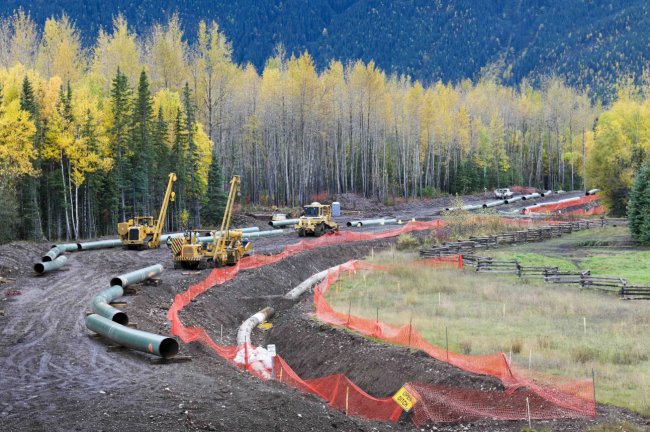
[Top photo: LNG pipeline construction in North Bear Lake, photo by Andy Wright]