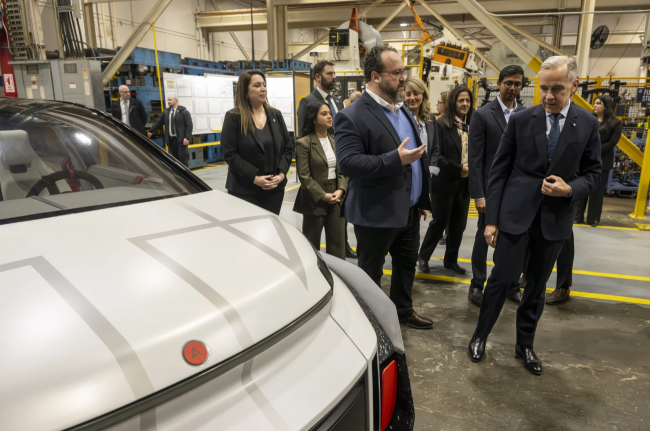
Another Justin Trudeau-era climate policy is now history: Prime Minister Mark Carney is scrapping the electric vehicle sales mandate and replacing it with “more stringent” fuel-efficiency standards and EV purchase rebates.
This proposed $2.3 billion EV Affordability Program would offer Canadians and businesses rebates of up to $5,000 for battery electric and fuel EVs, and up to $2,500 for plug-in hybrids over five years. However, the amount offered decreases each year, decreasing the amount in 2030 to $2,000 off a battery electric vehicle or $1,000 for a plug-in hybrid.
The rebates will only be available for Canadian EVs or EVs imported from countries with which Canada has a free trade agreement. This means Chinese EVs sold in Canada will not be eligible for the rebate.
On Thursday in Vaughan, Ont., Carney promised to drive down planet-warming greenhouse gas emissions by “more than doubling” the stringency of Canada’s vehicle GHG standards for vehicles models 2027 through to 2032. The Carney government claims this would be equivalent to achieving emissions reductions of a 75 per cent EV adoption rate by 2035. In a technical briefing before Carney’s news conference, government officials said they did not have the emission-reduction modelling to back up that goal.
Carney said slightly more during the announcement. Right now the standard is set at 172 grams per mile of driving and that would be changed to 74 grams per mile, Carney said.
“So it's a 57 per cent reduction in the emissions as this ramps up for the vehicles in the country,” Carney told reporters.
This gives industry a transition period and greater flexibility to choose how they meet those reductions across their fleets, while still “very clearly incentivizing investment in low, zero emission vehicle supply chain,” Carney said, adding that his government is “relentlessly focused on results,” a theme he repeated several times throughout the news conference.
PM Carney's new auto strategy dropped Feb. 5. Out: the EV availability standard (which would have required 100% EV sales by 2035). In: a $2.3B EV rebate program and more stringent tailpipe emissions regs (aiming for 75 per cent adoption rate by 2035 - BlueSky
From an GHG emissions standpoint, the proposed changes are a “huge setback” compared to the now-dead EV availability standard, according to Environmental Defence. The sales mandate would have required hybrids and EVs to make up “at least” 20 per cent of sales in 2026 and 100 per cent by 2035. Carney’s new auto strategy includes an “aspirational” goal to achieve a 90 per cent EV adoption by 2040.
It’s unlikely the 75 and 90 per cent EV adoption targets will be fulfilled simply by strengthening emission standards, Sam Hersh, Environmental Defence’s clean transportation program manager, said in a press release.
The auto strategy — and in particular the decision to axe the sales mandate — was quickly applauded by the Canadian Automobile Dealers Association (CADA).
Carney’s approach “is more in line with diverse technology, charging infrastructure and overall consumer demand, “ CADA President and CEO Tim Reuss said in a press release.
The auto sector holds considerable power — particularly in Ontario — and many auto sector groups and companies lobbied hard against the federal government’s sales mandate.
The strategy also revived an EV rebate program — with several tweaks — to help make EVs more affordable. The former program was popular, but ran out of money over a year ago.
Limited availability of EVs in Canada
Clean Energy Canada (CEC) characterized the new policy package as “a commendable alternative” to achieve the goals of the old EV availability standard, Joanna Kyriazis, director of policy and strategy at CEC said in a press release. However, she cautioned that Canada’s tailpipe standards have underperformed to date.
“Since 2011, passenger vehicle emissions have dropped a mere 1 per cent,” Kyriazis said in the news release.
“In fact, our passenger fleet pollutes more today than it did in 1990, as a loophole in our U.S.-aligned standards allows for larger, more polluting vehicles, undermining gains in efficiency and electrification.”
Kyriazis stressed the need to align Canada’s vehicle emission and safety standards with the EU and to open Canada up to European EVs, a stance echoed by the Canadian Climate Institute (CCI).
CCI president Rick Smith pointed out that there are currently more than 20 EV models selling for under C$40,000 in Europe but only one of them is available in Canada.
“Shifting away from sales targets to stronger tailpipe emissions standards echoes the approach taken in other major markets like the European Union,” Smith said, adding that the institute will examine the proposed regulations in detail to verify if this is a credible outcome and approach.
The regulatory changes are expected to be proposed and finalized this year according to government officials in the technical briefing.
Electric Mobility Canada president and CEO Daniel Breton is disappointed the government did away with the availability standard but is “cautiously optimistic” about the more stringent GHG emissions regulations. He applauded the continued investments in charging infrastructure and return of consumer rebates. However, the rebates only apply to vehicles under $50,000 — with the exception of made-in-Canada EVs — which is “too restrictive and risks excluding many vehicles Canadians need, particularly for families, rural residents, and tradespeople who need larger vehicles,” Breton said in the news release.
Other measures announced Thursday include exploring a tradable credit system that would reward companies for producing and investing in Canada, and allocating $3 billion from the Strategic Response Fund and up to $100 million from the Regional Tariff Response Initiative to help the auto industry. The Canada Infrastructure Bank’s Charging and Hydrogen Refueling Infrastructure Initiative will provide $1.5 billion in investments for the EV charging network. Canada will maintain counter-tariffs on auto imports from the US.